FIRST IN A SERIES
(NOTE: A lot of people have asked eyeoncleveland.com founder John Kerezy, “what are you going to write about the 2024 presidential election?” There will be a series of stories which are designed to illuminate some of the strategies and tactics we’ll be seeing as the campaign continues to unfold. Here is the first.)
AUGUST 28, 2024 — Many in America are becoming unwitting victims of propaganda campaigns. When 20-year-olds who don’t research the facts attend a pro-Palestine rally and join in chanting the slogan “From the (Jordan) River to the (Mediterranean) Sea, Palestine will be free,” they are indirectly calling for the abolition of the nation of Israel.
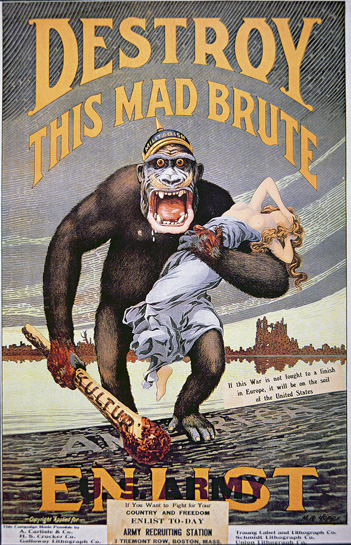
Little wonder, as one-fifth of all Americans ages 18-29 now believe that the Holocaust was a myth. That’s according to a survey from the Economist/YouGov, with results published at the end of 2023 in “The Hill.” Without full knowledge of the facts, it’s easy to fool the public. The strategy to make such opinion-changing possible is known as propaganda. Simply defined, propaganda is the dissemination of misleading and/or biased information aimed at influencing the opinions, beliefs, attitudes, or behaviors of people.
What are the major techniques that propagandists use? How has this come to light with issues of today, such as widespread anti-Israel sentiment? Why is there such hatred of a presidential candidate today (Donald Trump)? How can the public discern these tactics, and protect ourselves from them? How can we be on guard against overall efforts to misinform us?

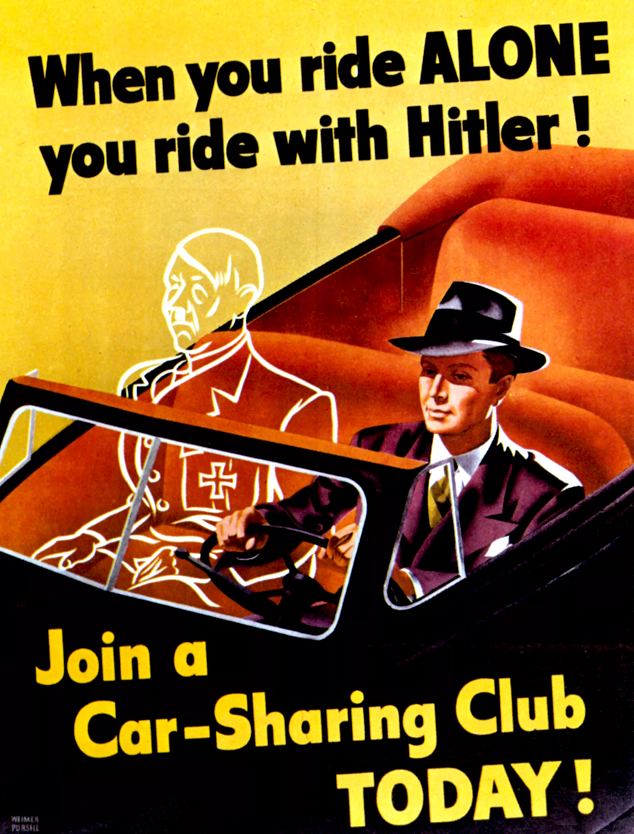
Here are some of the tactics that those employing propaganda use:
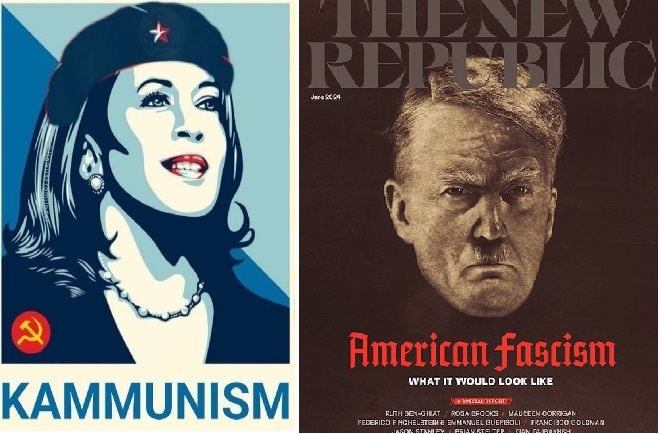
- Name calling — Using literal insults to call out the perceived shortfalls or inadequacies of an opposing side or candidate. Sometimes this takes on derision and downgrading of an opponent, often with the use of stereotypes and slurs. In World War II Nazi Germany, derogatory terms such as pigs, vermin, and other verbal slurs and insults were used to begin a campaign to get Germans to hate Jews. Adolph Hitler called Olympic great Jesse Owens and his Black teammates sub-humans. Equating Donald Trump to Adolph Hitler or Kamala Harris to a communist are examples of name calling in the 2024 election. (Author’s commentary: Hope we’d all agree that there is way too much name calling going on in politics today.)
- Transfer — Transferring the negative or positive value of something onto person or a cause by simple association. For example, a lot of political candidates will stand in front of an American flag in their advertisements and speeches.
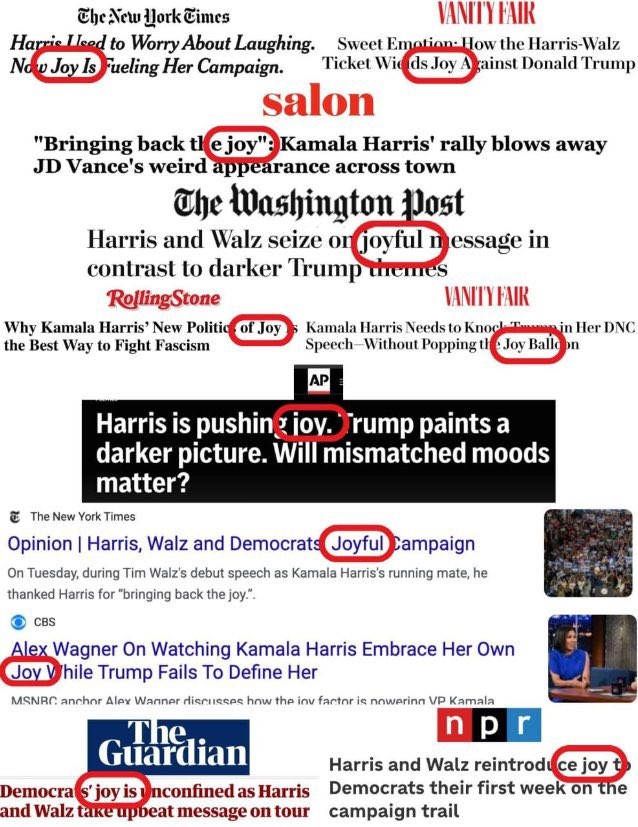
- Glittering generalities — Empty, fact-voided terms or words that make people, products or ideas should better than they actually are. This is a common practice in some political campaigns. For example, in the first days following VP Harris’s announcement that Minnesota Gov. Tim Walz would be her running mate, somehow the word “joy” appeared in the headlines of dozens of media outlets all over the United States. No issues of substance were discussed in the respective stories. (See below.)
- Testimonial — Endorsements, sometimes by celebrities, sometimes by a person who is actually an expert on a cause or a product. This is a common advertising technique. (e.g. four out of five dentists prefer Trident gum was a line used decades ago in commercials.) Testimonials can involve ethos, a rhetorical appeal that refers to the credibility or trustworthiness of the source of speaker. When Robert F. Kennedy Jr., suspended his candidacy for president on August 23, his announcement was also an ethos-type testimonial endorsement of Donald Trump.
WATCH: USA Olympic Skater Peggy Fleming appears in a testimonial ad for Trident gum. https://youtu.be/XBXHNvZ_kMg - Plain Folk — Nearly the opposite of testimonial, it employs the concept that “plain folk” like us are using the advertises product, supporting the advertised candidate, etc. “Just like us” is even a tagline associated with this (e.g. Minnesota Governor and VP Candidate Tim Walz.)
- Bandwagon — This encourages people to join in support of a candidate or cause because everyone else is doing it. Usually there is no critical thinking behind this technique. In a response to RFK Jr.’s endorsement of Trump, on Aug. 26., the Harris campaign announced that 200 former members of the Bush, Obama and Trump administrations were all endorsing her candidacy. Get on the bandwagon too is the inference.
- Card Stacking — A technique which lists only the positive features or aspects of a product or candidate, while downplaying a competitive product or candidate as negative or inadequate. Usually card stacking presents just a small part of the overall situation or picture.
It would be bad enough if only these tactics were at work in this election cycle. But here’s the reality: It’s far worse.
POISON
If one introduces a poison to your blood, how long would it take to spread through your circulatory system until it reaches every part of your body? After that, how long until your body feels its effects?
We must understand answers to those questions, from a rhetorical and public communication perspective, to better gauge what’s happened with our body politick. “A lie, repeated a thousand times, becomes the truth,” is one of the sayings attributed to Joseph Goebbels. He was the architect of a vast and evil propaganda campaign one which made is possible for Nazi Germany to exterminate millions of people.
Goebbel was the director of what became known in the Third Reich as the Ministry of Propaganda and Public Enlightenment. The Ministry controlled the press, literature, visual arts, film, theater, music and radio in Nazi Germany. Using some of the above-cited propaganda techniques, Goebbels and his subordinates sowed seeds of hatred within the German public for Jews and others.
Later still, Nazi Germany established 44,000 concentration camps. From those it killed as many as 17 million Europeans, including 6 million Jews.
But what if a group of people aimed the poison at just one person? What would it do? How long would it take to circulate until a vast majority of the public believed it?
Let’s aim poison – a false charge – at just one person, Donald Trump. Let’s begin by employing the media, who saw with a combination of embarrassment and astonishment that their own extensive coverage of Trump in 2015-16 helped him gain the Republican Party nomination for president.
So, why not use the media to spread a myth – a lie – attached to a premise which contains just a kernel of truth, Russian interference in the 2016 election campaign? Next, let’s add in one word – collusion — to imply that Trump campaign aides were in collaboration with Russian operatives, and get the FBI to investigate it and the media to widely disseminate it with stories.
That’s precisely what happened, beginning in July 2016.
But don’t just take this story as the truth.
For the first time in American history, there were actually two special prosecutors assigned to investigate the same event, the 2016 Presidential Campaign. The much better known of the two, the (former FBI Director Robert) Mueller Report, issued in 2019, was the focus of intense media coverage including televised hearings. The journalism profession awarded members of the press its highest honor – the Pulitzer Prize – for investigating the accusations that the Trump campaign colluded with Russia. It also resulted in the release of a 729-page book, “The Mueller Report” from the Washington Post and Scribner Books which became a best seller.
Then there was the second special prosecutor, John Durham, US Attorney for the District of Connecticut, whom (then) Attorney General William Barr tasked to “Investigate Matters Related to Intelligence Activities and Investigations Arising Out of the 2016 Presidential Campaign.” His report, issued in May 2023, had none of the media stories, televised coverage, or hoopla which accompanied the Mueller Report.
Durham’s report was smaller (316 pages), quite succinct and to the point. There is a link to it below if you want to read it (or parts of it) yourself. But, in short, Durham found no evidence whatsoever that there was collusion between the Trump campaign (or its affiliates) and Russia.
However, he did uncover a lot of evidence that the Hillary Clinton campaign, and those affiliated with the campaign, planted the story about Russian collusion with the FBI, and then got the media to write stories about it. Those supporting Clinton in the FBI then took and used the media stories they planted to Federal judges to help obtain warrants to conduct surveillance on those near the Trump campaign. They continued to re-apply for court surveillance, even after initial warrants uncovered zero evidence of collusion.
Durham’s findings included the following:
- The FBI failed to uphold its important mission of strict fidelity to the law in connection with “certain events and activities” described in the report.
- A (now former) FBI attorney committed a crime by fabricating language (lying) in an email that was material to the FBI obtaining a FISA (Foreign Intelligence Surveillance Act) court order.
- FBI personnel also “repeatedly disregarded important requirements when they continued to seek renewals of FIS surveillance … they did not genuinely believe there was probable cause to believe that the target was knowingly engaged in clandestine intelligence activities on behalf of a foreign power….”
- “… senior FBI personnel displayed a serious lack of analytical rigor toward the information that they received, especially information from politically affiliated persons and entities.”
- “In particular, there was significant reliance on investigative leads provided or funded (directly or indirectly) by Trump’s political opponents.”
But by 2023, the poison was already in the system we call the body politick in America. Survey after survey shows that nearly half of all Americans believe that Trump colluded with Russia in the 2016 election campaign. Once poison is in the circulatory system, it’s very difficult to get it out. Yet that’s where we all in the fall of 2024.
Download the Durham Report here:
Let’s be clear – Russia DID try to influence the 2016 election. We’ll cover that in greater detail in a future part of this series. Just watch the first few minutes of the video linked at the end of this paragraph for proof of it. But there was no collusion between Trump and Russia. If anyone colluded with Russian intelligence, maybe intentionally but most likely unintentionally, Durham’s report make it clear that it was the operatives of the Clinton campaign who sought out what turned out to be misinformation from Russia-tied sources. Link: https://www.youtube.com/watch?v=yFHcEwhuHhs&t=4s
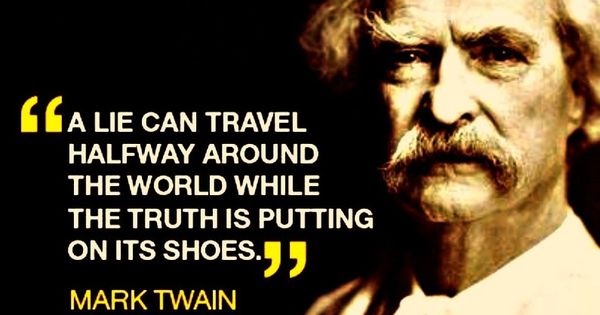
The Durham Report’s findings received, probably, less than 1 percent of the media attention that the Mueller report earned in news coverage. Mark Twain was right.
PREVENTION
Is there a way to prevent propaganda from overtaking all aspects of our body politick? Might it be possible to inoculate ourselves from propaganda, misinformation, and poisonous diseases which are ravaging public discourse in America? In democracies?
Sander van der Linden thinks so. A professor at the University of Cambridge in the United Kingdom, he’s also been conducting research on behavior and psychology for decades. He’s a regular advisor to governments and social media outlets about fighting misinformation.
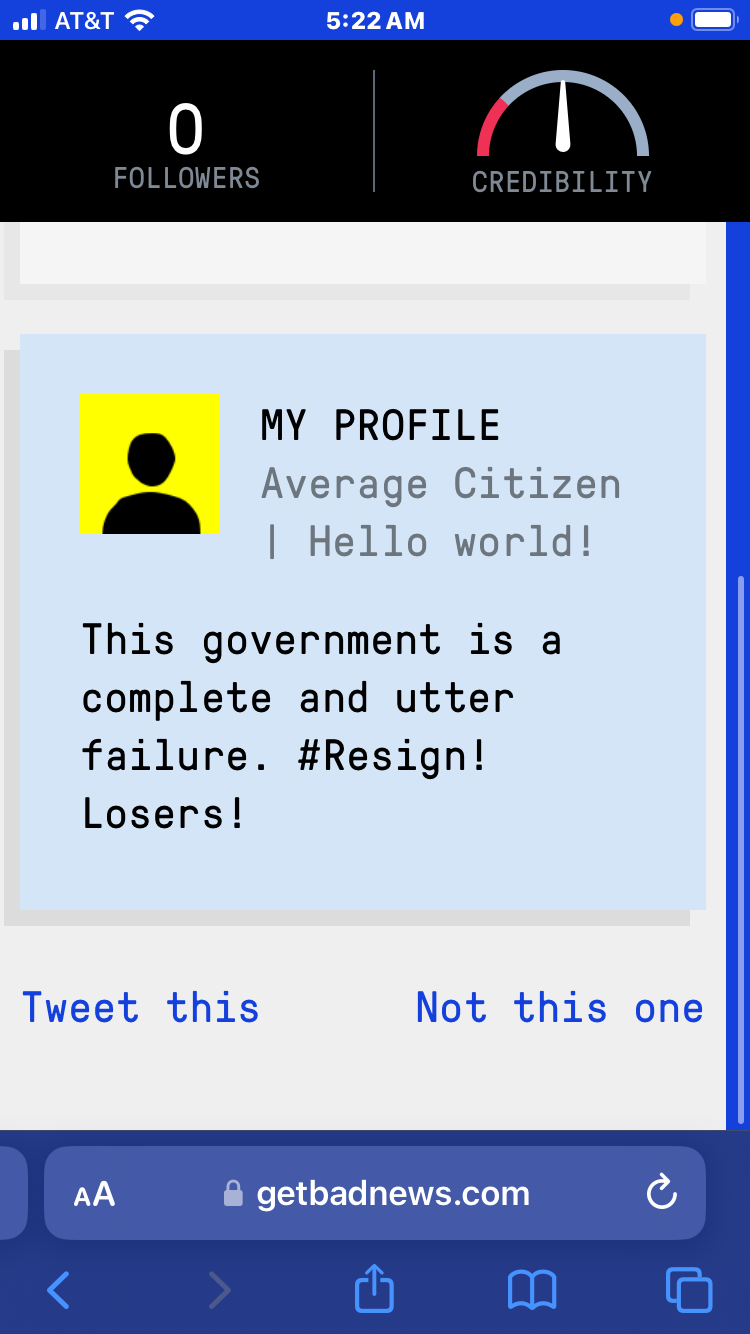
Van der Linden and his colleagues have developed a theory that – like smallpox or polio – disinformaton is a virus which can be treated effectively through a form of vaccination. Unlike a medical vaccination, administered orally or via a shot, the vaccination against disinformation requires taking (or getting) knowledge. Along with Jon Roozenback and Ruurd Oosterwoud, van der Linden developed a “disinformation simulator” – a game basically – which actively “inoculates” the players by having them recognize the major tactics which disinformation campaigns employ.
Players are “awarded’ with badges as they demonstrate an understanding of the six major disinformation tactics, with the acronym of DEPICT, for discrediting, emotion, polarization, impersonation, conspiracy and trolling.
Research which the three conducted on late-age teens (16 to 19 years olds) demonstrates that the simulation is quite effective.
Try it yourself. Here’s a link: www.getbadnews.com For years now, people form all walks of life have asked me “what can be done” to stop the spread of misinformation. This is a gamification of the first-ever easy response to that question. Below are a couple of screen shots from the game.
There will be more about van der Linden’s work in Part Two of this series. We’ll also cover two of the common types of political attacks, and discuss framing and agenda setting as well.

FINALLY
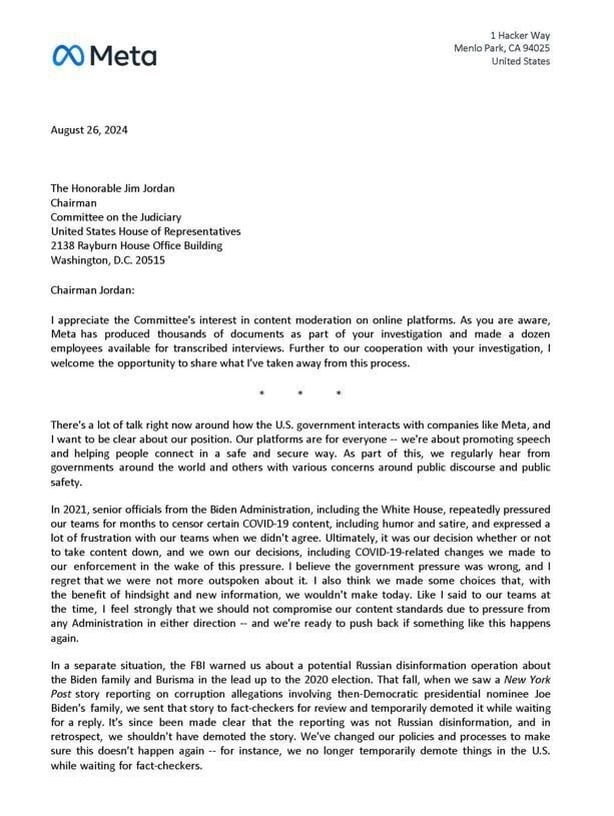
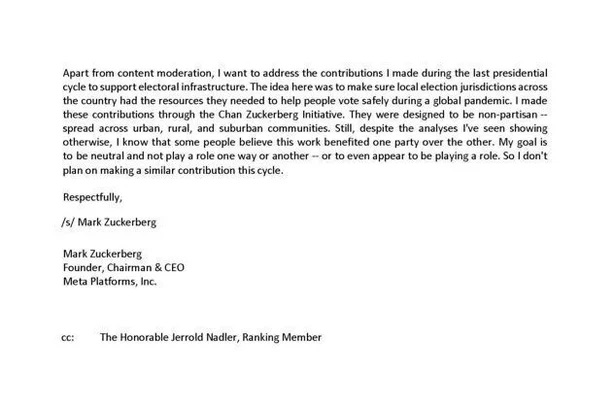
As I wrapped up writing this article, Meta Corp. Chair and CEO Mark Zuckerberg made news headlines through a letter he sent to the US Congress Judiciary Committee through its chair, Cong. Jim Jordan. Essentially, Zuckerberg admitted that Meta had succumbed to pressure from the Biden Administration to censure — to degrade and remove — content from its Facebook and other platforms about Covid-19.
For years, Republicans in Congress have complained that social media and tech companies are suppressing or censoring conservative views. Zuckerberg’s letter certainly provides proof of that. But more chilling is the acknowledgement that the world’s leading media outlet (in terms of users) bowed down to the Biden-Harris Administration. This news should alarm every champion of the five rights enunciated in the First Amendment to the U.S. Constitution.
“I believe the government pressure was wrong, and I regret that we not more outspoken about it,” Zuckerberg wrote.
The letter is reprinted below. Look and judge for yourself.
SOME SOURCES USED FOR THIS ARTICLE
Lippmann, W. (1922). Public opinion. Harcourt, Brace.
Lasswell HD. The theory of political propaganda. American Political Science Review. 1927; 21(3):627–631 https://doi.org/10.2307/1945515
Frederica Marsi, Al Jazeer, November 2, 2203, from https://www.aljazeera.com/news/2023/11/2/from-the-river-to-the-sea-what-does-the-palestinian-slogan-really-mean
Nick Robertson, “1 in 5 young Americans think Holocaust was a myth,” Dec 8, 2023, from https://thehill.com/homenews/education/4349815-poll-americans-holocaust-myth/
US Holocaust Memorial Museum, https://encyclopedia.ushmm.org/content/en/article/ministry-of-propaganda-and-public-enlightenment
Van del Linden, Sander, “Foolproof: Why Misinformation Infects Our Minds and How to Build Immunity,” 2023, W.W. Norton
Adobe Express produced a poster on propaganda as part of its efforts to sell its products. Here’s a link: https://www.adobe.com/express/learn/blog/ultimate-guide-propaganda
 eyeoncleveland