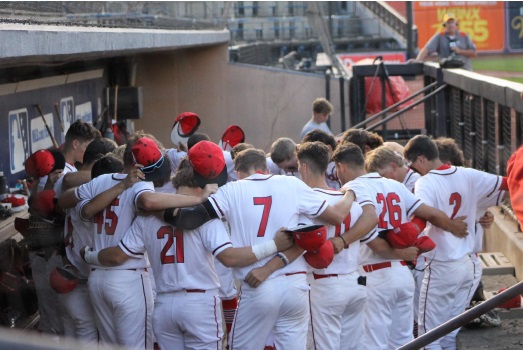
Hiland raising funds for turf surfaces
on its baseball and softball fields
By JOHN KEREZY, eyeoncleveland founder
BERLIN, Sept 25 – Scheduling. Safety. Flexibility. Better usage. Community. Those are five of the many reasons why Hiland Athletics is seeking to replace its dirt-and-grass ball fields with high-quality artificial turf.
The $477,000 project would replace the softball and baseball fields with high-quality artificial surfaces from ForeverLawn of Ohio. It’s a project born out of both necessity and reality.
(NOTE: There is an FAQ and other background information about the Turf Project at the end of this article for downloading and reading.)
The necessity centers around the weather and scheduling. Turf fields drain water quickly due to their built-in drainage systems and non-absorbent nature. Grass fields can become muddy and slippery in wet conditions, making them unplayable. In general, turf can be used for longer hours and in variable situations (such as changing the diamond dimensions) as well.


“It rains a lot in the spring, and that leads to frequent game cancellations or delays,” says John Monigold, one of the 14 Turf Project Committee members. Monigold is the father of three boys on the Hiland Baseball squad, a teacher at Wise Middle School, an umpire, and occasional radio color commentator on WKLM-FM for high school baseball as well.
“We had 19 games in 20 days at one point in this past season at Hiland, due to rain,” Monigold adds. “I’d get calls to go and umpire at places such as Garaway and Indian Valley – schools which already have turf surfaces – on days when our boys stayed home due to rain postponements.
“It seems that every tournament game our guys played on this summer was a turf surface,” Monigold adds. “Dover and New Philadelphia are adding turf fields. Jackson High School and Louisville have turf too, and Canton McKinley HS has two turf fields. They get in more of their scheduled games with turf.”
Turf playing surfaces are safer as well. While every softball and baseball squad member dreams of the idea of playing on a perfectly-maintained dirt infield and excellently-manicured grass, reality is far from that. Outfields change over time, as variations in grass height and thickness affect the playability of the field. On the infield, years of usage create uneven areas and even bad-hop spots on the dirt.
“We’re very proud of Lehman Field, but it takes more maintenance than our grounds team can do to keep it in terrific shape. It has blemishes and is showing its age,” says Chris Dages, head baseball coach at Hiland and another Turf Committee Member. Leader of the Hawks’ back-to-back state championship teams, Dages is entering his ninth year at the helm of Hiland baseball. “Mr. Lehman himself would come out and help maintain the field, voluntarily, until he died several years ago.”
Turf surfaces also lead to better and more predictable field usage. Community events, such as softball tournaments, can be better scheduled and held knowing that inclement weather is less of a factor. (More on this below.)
Once installed, turf surfaces drain quickly, are far less expensive to maintain, and save the installing school district money. One estimate puts the price tag of maintaining a natural baseball or softball diamond surface at $20,000 a year, as the field must be mowed, watered, fertilized, aerated, lined, and repaired. Artificial surfaces cost only about 25 percent of that amount in maintenance. For East Holmes, that difference could amount to about $30,000 a year in savings on maintaining the baseball and softball fields.
SOFTBALL FIELD: ADDITIONAL CHALLENGES
The location of Hiland’s softball field helps contribute to a constant battle against water and mud in springtime. Like the baseball field, the softball diamond sees heavy usage. Besides the Lady Hawks squad, there are 10U, 12U,and 14U teams using the field as well. In fact, hundreds of Hiland students of all ages are part of the boys or girls ball programs. But the softball field’s location poses unique problems.
Girl’s softball coach Kari Sparling, who’s entering her fourth season at Hiland and is also a member of the Turf Committee, points out that the field is in a bowl-like depression below and adjacent to Ohio Route 39. Also – unlike the baseball diamond — the softball infield is all dirt. Anytime there is a heavy rain, water drains down from the roadway onto the playing field.
“Our grounds staff works hard on the softball field, but it’s always a challenge whenever there’s a rain. Getting rid of the mud can be very hard, and we actually lose four or five games a season due to rainouts,” she points out. “And with four teams sharing the field, it sees a lot more action than most observers realize.”
Full Lady Hawk team practices start the last week of February, and that also has its own challenges. “A natural dirt field makes outdoor practice nearly impossible because the ground is usually frozen, or it thaws and re-freezes rapidly at that time of year,” Sparling adds. “This can make field conditions not safe to practice on, limiting our ability to work full field practices.
“We have great indoor facilities, but we cannot put a full field together inside and practice running defensive situations like could if we were able to get out onto the field earlier,” Sparling explains. “Turf would provide that opportunity.”
Additionally, the softball surface is an “old” field in that the boys’ baseball team used the diamond prior to construction of Lehman Field. It has seen a lot of service over the decades. “There’s a buildup of dirt where the infield ends and the outfield grass begins at the lip of the outfield. That contributes to a lot of bad bounces on the field,” Kari points out.
PLAYER PREFERENCES AND SAFETY FACTORS
Kaden Kandel is a senior pitcher and infielder with the Hiland Hawks. He’s played hundreds of games, including dozens of contests on artificial turf. He says there’s no comparison between the two surfaces.

“The ball always bounces precisely on artificial turf. You can always tell where it’s going, and that gives me confidence,” he explains. “That gives everyone else confidence too. No bad hops to the jaw or other part of the body.”
Kaden and other Hawk players say that their home field looks good, but that looks can be deceiving.
“At times we have bad bounces at Lehman Field. When dirt goes under the lip of the grass after a raking, it creates – well – interesting bounce possibilities,” he says. “A routine ground ball can go erratically over your head. That doesn’t happen with turf.”
Monigold knows this too. “We have bad spots which have developed on the dirt at Lehman Field,” he adds. “Recently we had a batted ball hit one of the spots, bounce funny, and fracture an eighth-grader’s nose.”
Last year, the Hawks practiced for the Regional semis and finals at Garaway High School during their successful playoff run. “If we could practice every day on artificial turf, it would be a huge help to our preparation,” Kaden adds.
COMMUNITY AND TOURNAMENT BENEFITS TOO
Once artificial surfaces are in place, Hiland Athletics can schedule games with great confidence knowing that weather will have much less of an effect when the umpire yells “Play Ball!” to start the contests.
This means that events which raise money for the athletic programs, such as Amish Softball Tournaments, can be better scheduled and held. Additionally, community teams can make better use of the fields in the summer, out-of-school months as they require less maintenance.
Artificial turf would also open the door to more possibilities that regional and even state tournaments might be held at Hiland.
“It seems that all district and regional tournament games are scheduled now on turf fields,” Dages points out. “Our players and fans know there’s a high likelihood the games will go on as scheduled when we play on turf. With the OHSAA expanding to six divisions now, turf would make it possible for us to host games at Hiland as well.”
HOW YOU CAN HELP
The Turf Project Committee has already raised $75,000 of the needed $443,760 for the two artificial surfaces. You can help with a tax-deductible check made payable to East Holmes Council Inc. and mailed to Hiland Athletic Boosters PO Box 268 Berlin, OH 44610. If you are in a position to make a donation of $5,000 or more, you’re welcome to call Committee Member Matt Miller of First Federal Community Bank, in Berlin, at 330-893-2221.
You can download an entire packet of information about the Turf Project, including FAQs, here:
SOURCES USED FOR THIS ARTICLE INCLUDE
Interviews with Chris Dages, Kaden Kandel, John Monigold and Kari Sparling .
 eyeoncleveland