
First in a Series (see note at bottom)
Want to be the trivia master in your community when it comes to blimps? Here you go! Eyeoncleveland.com presents this Blimpology in honor of Goodyear’s 100th anniversary of building and flying airships.
On Tuesday (June 3), three Goodyear Blimps will be flying over Akron to celebrate the 100th anniversary of the company’s first blimp flight. The second story in this series will cover some details of that celebration. But below is an “A to Z” compendium of history and some facts about Goodyear and its history with the Goodyear Blimps. Hope you enjoy it!
AKRON – America’s fastest growing city from 1910 to 1930 was Akron, and it was among the 40 most populous cities in the U.S. in both the 1920 and 1930 Census. The reason could be summarized with one word: Rubber. General Tire, B.F. Goodrich, Firestone Tire & Rubber, and Goodyear Tire & Rubber Company all had their start in or around Akron, and all four were booming with the post-World War I economy and the growing demand for tires on vehicles. The companies were hiring any workers they could find in the Roaring 1920s.
The City of Akron’s population burgeoned from 69,000 in 1910 to 210,00 in 1920, and then to nearly 300,000 by 1925. Official population was 255,040 in the 1930 Census (taken after the onset of the Great Depression). Business growth was so rapid that some of the companies (particularly Goodyear) built their own neighborhoods and houses (Goodyear Heights) for their workers. Akron was among the 50 most populous cities in America for more than 50 years, and its population peaked at more than 290,000 residents, according to the 1960 US Census.
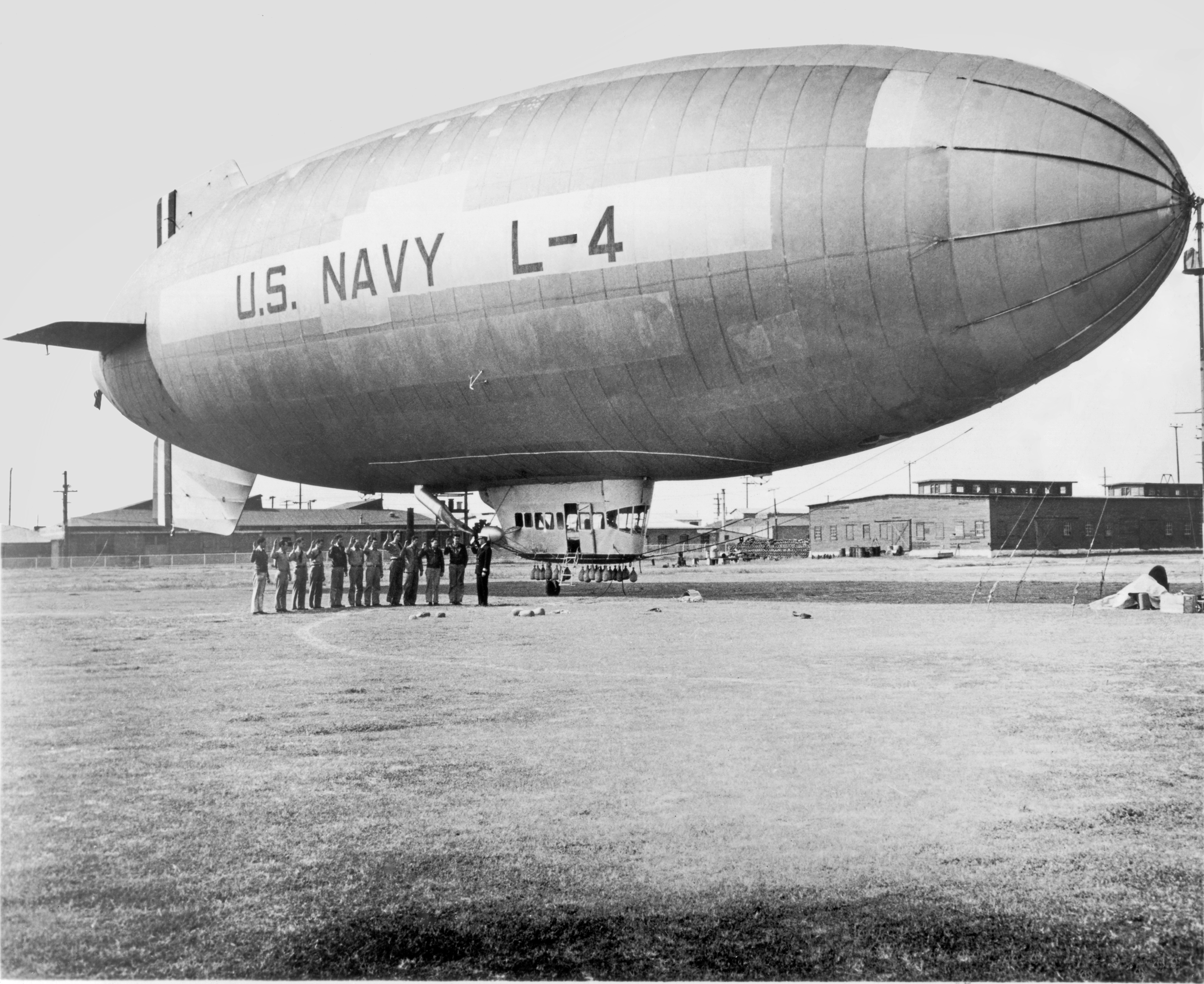
AVIATION – About 100 years ago, aviation experts were divided about whether the future of commercial air travel would be dominated by fixed-wing aircraft or non-rigid airships such as blimps. Goodyear, which had been experimenting with lighter-than-air ships since 1910, built its first balloon in 1912. Goodyear decided to continue with research on and construction of airships, leading to the establishment of its first air base at Wingfoot Lake and then later still the Goodyear Airdock (see entries below). Goodyear expanded its fleet and build airships for the US Navy in the 1930s. With World War II approaching, Goodyear accelerated its blimp production, and also built more than 4,000 of the Vought F4U Corsairs for the Navy and Marine Corps.

Additionally, It made components for many other airships, including the B-29, with its Goodyear Aircraft division. After the war, Goodyear continued blimp research and production and expanded its aviation interest when it changed the aircraft division name to Goodyear Aerospace (See below).
BATHROOM – Yes, there is a bathroom on board all of Goodyear’s blimps.
BIG EVENT – The saying “If it’s a big event, the Goodyear Blimp is there” is certainly true. Examples include the first Super Bowl, Summer & Winter Olympics, Royal Weddings, Academy Awards, World Series, Daytona 500, Indianapolis 500, Kentucky Derby, NBA Finals, the PGA Championship and College Football National Championships. Goodyear’s Wingfoot Three began 2025 by covering the College Football Playoff’s Rose Bowl quarterfinal game between the Ohio State Buckeyes and the Oregon Ducks (won by Ohio State, 41-21) It marked the 70th anniversary of the Goodyear Blimp’s first coverage of the Rose Bowl (see entry below).
CARSON. CALIFORNIA – Goodyear has a 27-acre blimp base here. Opened in January 1968, it has been home to nine different blimps so far. Currently it hosts Wingfoot Three, which is joining Wingfoot One and Wingfoot Two for the centennial celebration of blimps over Akron June 3-4-5. The airbase is home for West Coast operations for the Goodyear Blimps. All four of Goodyear’s bases have huge hangars where the blimps can receive service, repairs, and upgrades.
CHRISTENERS – Goodyear christens is blimps. Famed aviator Amelia Earhart, Sally Ride (the first American woman in space) and ABC’s Good Morning America host Robin Roberts are among those who have christened blimps.
DISASTER ASSISTANCE – Goodyear Blimps have helped save lives. In October 1989, the blimp Columbia was covering game three of the World Series in San Francisco when a 6.9 (Richter scale) earthquake struck. The disaster claimed 63 lives, injured more than 3,700 people and caused $6.8 billion in property damage. Columbia immediately began providing aerial views of the damage, with the pilots’ eyes helping California authorities best direct first responders to the disaster.
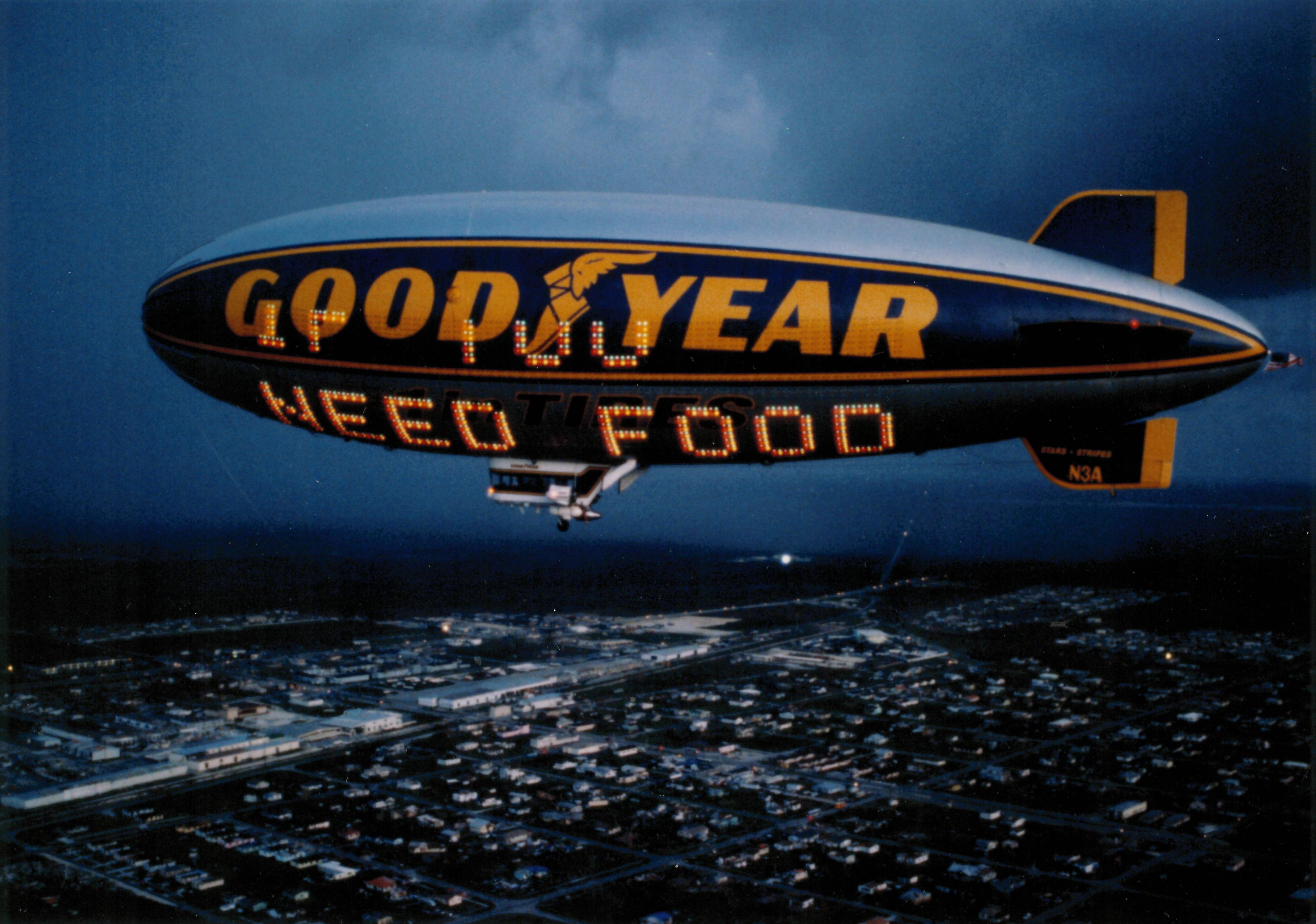
Three years later, when Hurricane Andrew struck Florida, Goodyear’s Stars and Stripes took to the air and used its electronic signage to give disaster relief information to thousands of homeless and stranded Floridians.
EUROPE/ESSEN – Essen, Germany, is home to the European Goodyear Blimp base. The current Europe Blimp first took to the skies in 2020. It covers sports events, such as the 24 hours of Le Mans, across the European continent. This blimp is operated by Deutsche Zeppelin-Reederei GmbH.
GIFFARD – Frenchman Henri Giffard designed the first successful airship in 1852. Giffard filled a 144-foot long bag with hydrogen and used a steam engine to turn a propeller attached to the bag. The first flight departed from what later became the Paris Hippodrome (a horseracing track) and traveled 20 miles, demonstrating the usefulness of the invention.
GOODYEAR – Frank Sieberling, inventor of vulcanized rubber, co-founded Goodyear Tire & Rubber Company in 1898. Today, Goodyear is best known for manufacturing tires for passenger vehicles, aviation, commercial trucks, military and police vehicles, motorcycles, recreational vehicles, race cars, and heavy off-road machinery. It is one of the five top tire manufacturers in the world. Mark Stewart is the chairman, president, and CEO of Goodyear.
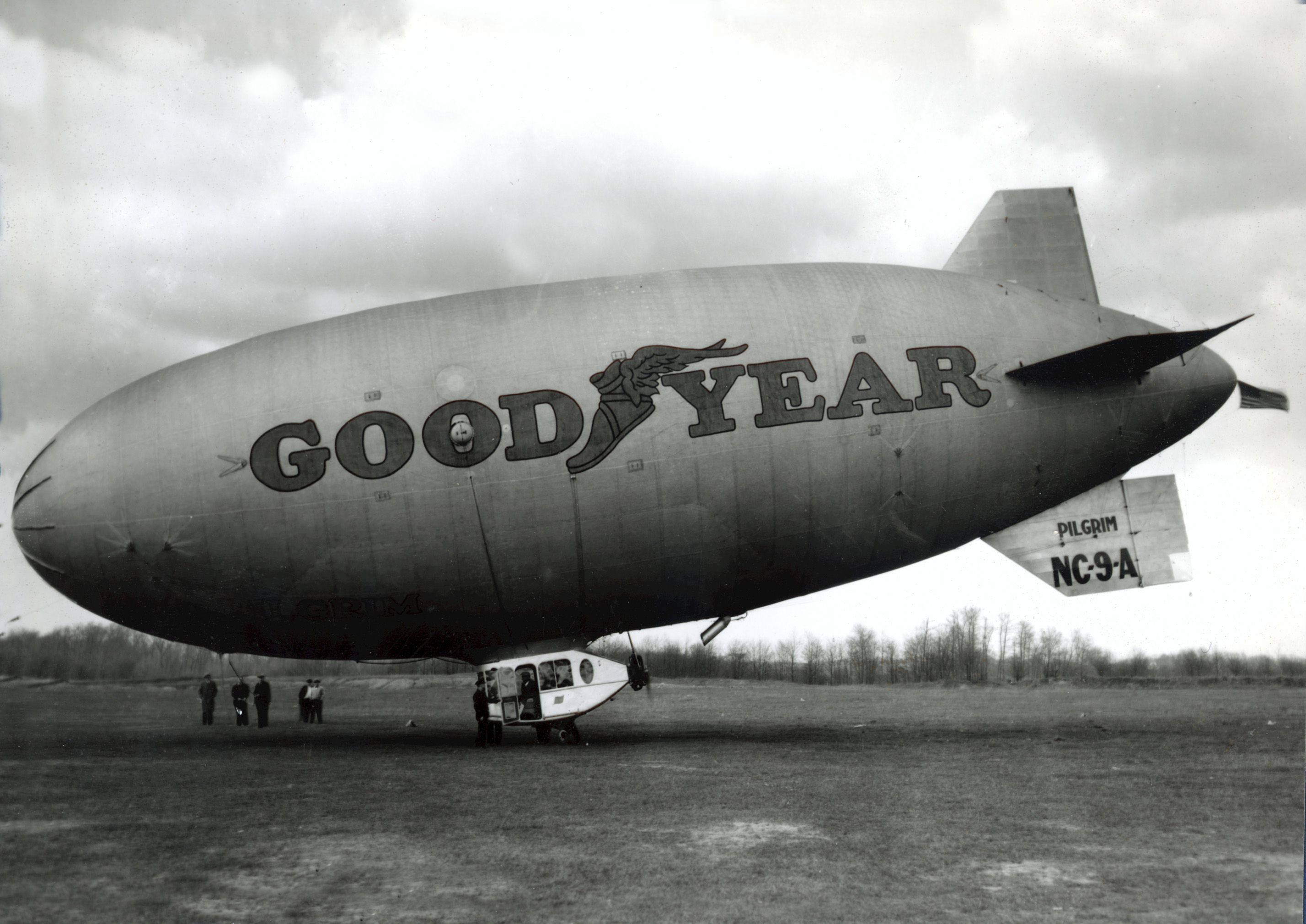
George Stadelman was president of Goodyear from 1923-1926, when the company leveraged its development of the Supertwist cord to launch balloon tires and expand its pneumatic tire business. He also was in charge when the blimp Pilgrim was launched in 1925 (see entry below). Stadelman’s successor, Paul W. Litchfield, led Goodyear for 30 years. He saw the company through many important advances in design and materials. He also partnered with Germany’s Zeppelin company to become a major force in the airship market.
GOODYEAR AIRDOCK – When it was completed in 1929 and for 40 years afterwards, the Goodyear Airdock was the largest building in the world with no interior supports. The American Society of Civil Engineering gave it landmark status as part of its Historic Civil Engineering Landmark Program in 1980. Goodyear’s Litchfield envisioned that eventually there would be fleets of passenger-sized blimps carrying passengers across the US and across the oceans as well. He wanted Goodyear – and Akron – to be at the center of this.
Litchfield instructed his chief of engineering, German émigré Karl Arnstein, to design the Goodyear Airdock hangar so large that it could handle two large airships which the US Navy wanted built. “Make the hangar big enough for a 10,000,000 cubic foot airship,” Litchfield instructed Arnstein. The engineer went bigger still, large enough to accommodate a 15 million cubic foot airship. (See USS Macon and USS Akron entries, below).
Adjacent to Akron’s Fulton Airport on Akron’s East Side, the Goodyear Airdock is 1,175 feet long, 325 feet wide, and 211 feet tall. It has 364,000 square feet of floor space and a volume of 55 million cubic feet. About 30,000 people attended the christening of the USS Akron, the largest airship in the world at the time, including First Lady Lou Henry Hoover, in the Goodyear Airdock in 1931.
At its peak in the Cold War era, the hanger and five plants adjacent to it employed 30,000 people under the corporate name of Goodyear Aircraft, and later Goodyear Aerospace. It is visible from the air from 20 miles away on a clear day in Northeast Ohio. Today Lockheed Martin Corp owns and uses the Goodyear Airdock.
HELIUM – Goodyear’s blimps, beginning with Pilgrim, were the first commercial non-rigid airships to use helium as their lifting gas. Because of limited supply, true even today, Congress passed and President Coolidge signed the Helium Control Act of 1927, which prohibited the export of helium (see Zeppelin entry) . This forced the Germans to use highly flammable hydrogen for its airships.


Hydrogen has 1/16th the density of air, while helium is 1/8th the density. Helium has other medical and aerospace usages. For example, helium superconducts magnets in MRI machines.
HINDENBERG – Designated D-LZ 129, the Hindenberg was the largest German commercial passenger airship of its time. Completed in early 1936, it ferried passengers across the Atlantic Ocean and was also employed as a flyover in the opening ceremonies of the 1936 Summer Olympics in Berlin (perhaps the first athletic event to have a blimp). The Hindenberg crashed and burned while attempting to land in Lakehurst, NJ, on May 6, 1937. There were 74 passengers and crew on board the craft; 36 of them lost their lives.
LIGHTED SIGN – In 1930, the Goodyear Blimp Defender becomes the first airship in the world to carry a lighted sign. Dubbed Neon-O-Gram, the sign was made of 10 removable aluminum-framed panels holding neon tubes. Each panel weighed 35 pounds and stood 6 ft. tall and 4 ft. wide. Dozens of technological improvements later, Goodyear Blimps today can show words and pictures via LED lights on their exterior.
MASTS — Blimps dock — take off and land — from masts, which are designed to secure the airships so the wind doesn’t take them away while on the ground. They are sophisticated towers with fittings at the top where the blimp’s mooring line(s) are attached. Goodyear has masts at all of its airship bases, and also has an 18-wheel truck for mobile landing and take-off locations. Most masts are 60 to 210 feet tall. There’s still a mooring mast atop the Empire State Building, by the way.
NAMING CONVENTIONS – Early Goodyear Blimps were named for winners in the America’s Cup yacht races (such as Resolute and Defender). Next, names which celebrated America (such as Columbia and Stars and Stripes) were used. Today they have names and numbers that go back to Goodyear’s blimp origins: Wingfoot One, Wingfoot Two, and Wingfoot Three in the U.S. (see below).
NORTH POLE – Polar explorer Roald Amundsen flew with 15 others in the airship Norge over the North Pole, from Ny-Alesund, Norway, to Teller, Alaska, in May 1926.Norge had three engines, and its top speed was about 80 km/hour (50 mph). It was the first airship to fly completely across the Arctic Ocean, and the expedition dropped American, Italian and Norwegian flags at the North Pole. A pilot on the flight, Hjalmar Riiser-Larsen, accurately predicted that in the future airships and airplanes would use the “Great Circle” route to save time and distance when flying.

PASSENGERS/CHARITABLE CAUSES – About 99.95 percent of the general public has never flown on a blimp. Most blimp flights are reserved for Goodyear customers, by invitation for special circumstances, or for those who purchase a Blimp Certificate at a charity auction. Goodyear donates these passenger Blimp Certificates to charities across the U.S. to auction. This turns the public’s interest in flights into funds that then directly benefit the charities. Goodyear estimates that charities receive more than $500,000 per year from Blimp Certificates.
PILOT AND CREW — There are more astronauts in the world than there are blimp pilots. Goodyear currently has 10 full-time pilots who fly their four-blimp fleet. Blimp pilots must first obtain an FAA commercial pilot license, then undergo an additional 250 hours of training to earn an additional FAA Lighter-Than-Air rating.
There are two pilots behind the controls whenever the Goodyear Blimp flies. Blimps can also carry up to 14 passengers (See just above). A three-person ground crew assists with takeoffs and landings. A full service and support crew of up to 20 travels with the airship whenever it is on the road.
PILGRIM – Goodyear chose to give its first blimps the names of yachts which competed for America’s Cup, the sailing competition between Great Britain and the United States. Pilgrim was named after a yacht which was built in 1893 and vied to represent the U.S. in the 1895 America’s Cup.
POMPANO BEACH — Opened in 1979, the airbase at Pompano Beach is the home of Wingfoot Three, which Akron’s philanthropist and businesswoman Savannah James christened in 2016. The full airbase of 650 acres includes the Pompano Beach Airpark; Goodyear leases about 32.5 acres of the Airpark for its airbase operations. Wingfoot Three made history when it became the first blimp in more than 50 years to serve as a jump platform for parachutists. Members of the US Air Force Academy Wings of Blue Skydiving Team made a leap from the blimp to the Bristol Motor Speedway in September 2016. (See Carson, California, and Wingfoot Lake, Ohio entries)
PONY BLIMPS — Goodyear built its first non-commissioned airship, the Wingfoot Air Express, in 1919, and produced three more of a new model known as a Pony Blimp. Just 95 feet long, the Pony Blimps were shipped to air shows across the country to showcase the potential for everyday lighter-than-air travel.
PUBLIC RELATIONS – One working definition of the term public relations begins with the words “a planned effort to influence public opinion…” and the Goodyear Blimps are just that, serving as public relations vehicles to “drive” brand awareness for the company and to delight fans in communities all over the world. The Goodyear Blimp is certainly the biggest, and perhaps the most iconic and long-lasting corporate brand asset in the world today.
ROSE BOWL — One of the first major sports events where the Goodyear Blimp made regular appearances is the Rose Bowl, beginning in 1955. That blimp provided live aerial video coverage of both the Rose Bowl Parade and the January 1, 1955, game. On January 1, 2025, Goodyear’s Wingfoot Two again covered both the Rose Bowl Parade and game, providing spectacular views of the stadium, the San Gabriel Mountains, and sunset over the mountains.

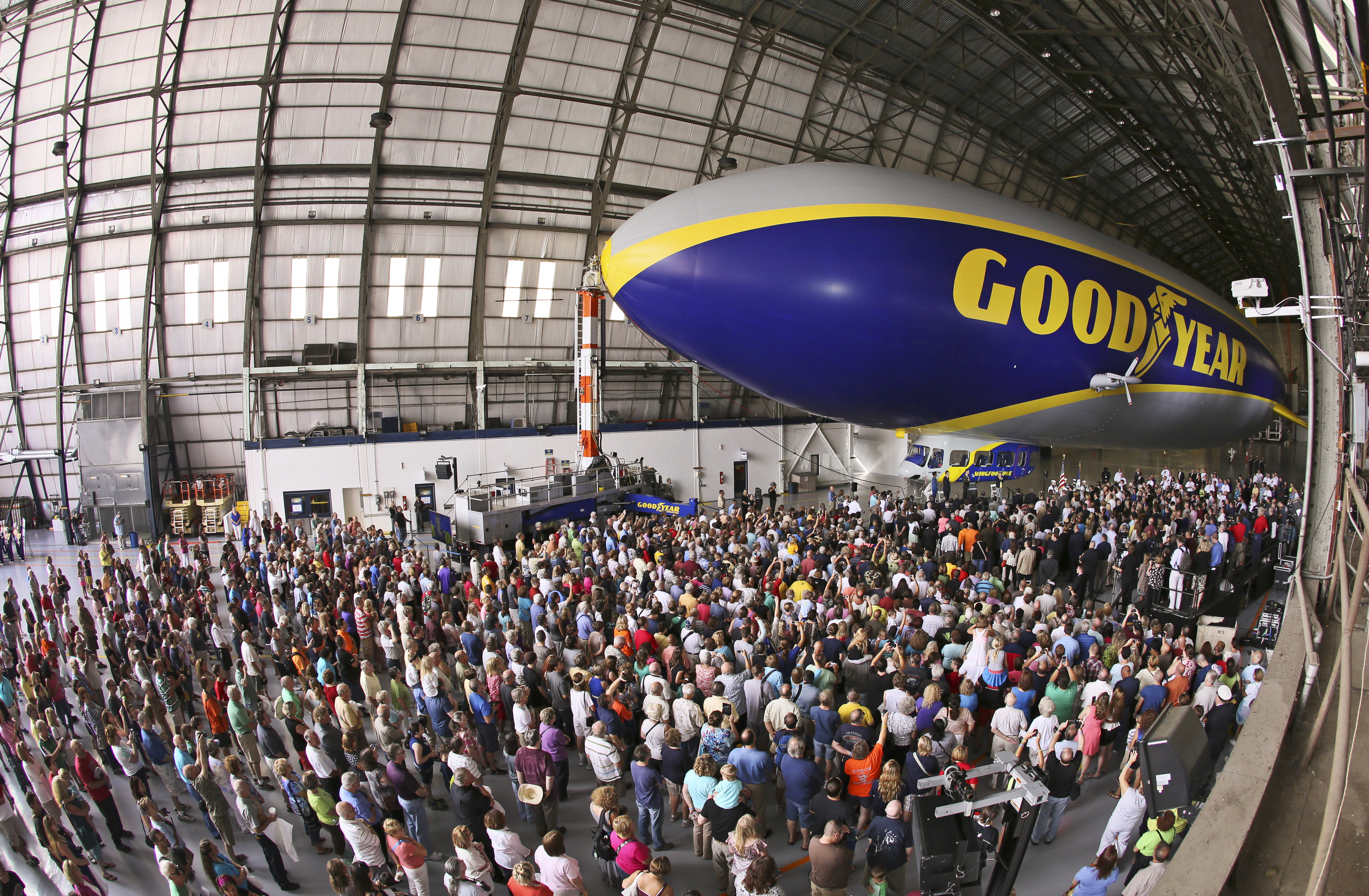
SEMI-RIGID – Before the 21st Century, Goodyear’s blimps could be fully deflated. Today all blimps are semi-rigid airships, meaning that they have an internal frame. In 2011, Goodyear decided to transition to a Zepplin Corporation platform called NT (New Technology), which improves the airship’s maneuverability and speed. The first NT model Goodyear Blimp, Wingfoot One, began operating in 2014.
TOYS FOR TOTS – Want to see a Goodyear Blimp up close? Make a donation to the U.S. Marine Corps Reserve’s Toys for Tots in December, and bring the donation to one of Goodyear’s three airbase locations Ohio, Florida or California. Toys for Tots is one of many organizations which partners with Goodyear around the Goodyear Blimps. (Watch local media for details.)
USS AKRON AND USS MACON – The US Navy ordered airships USS Akron (designated ZR-3) and USS Macon (ZR-5) from Goodyear in an era preceding radar. Both were 784 feet long and had a cruising speed of 63 miles per hour. USS Akron first flew in 1931, and USS Macon in 1933. Each were referred to as “flying aircraft carriers,” having hangar space in the airship for five Curtiss F9C Sparrowhawk fighter planes. They were designed so that the fighters could be lowered from the belly of the blimp for take-off, then reattached to the blimp via a trapeze system for retrieval and storage.
The system worked, but tragically the blimps didn’t last. USS Akron crashed off the New Jersey coast in 1933, and USS Macon disappeared off the California coast in 1935. There is a U.S. Naval Institute story (source linked below) with details about these tragic losses.
WHEN GIANTS ROAMED THE SKY – If you want to be the smartest person on your block about the early days of Goodyear’s blimp making, read Dale Topping’s book “When Giants Roamed the Sky: Karl Arnstein and the Rise of Airships from Zepplin to Goodyear” (Akron, University of Akron Press, 2000)
WINGFOOT LAKE, OHIO – Wingfoot Lake in Mogadore, Ohio, houses the first and oldest continuous blimp base in the U.S. Goodyear purchased 720 acres of land in southwest Portage County, to begin manufacturing its own blimps in 1916. The 444-acre lake at the site, named Wingfoot Lake, provided water needed for the construction. The hangar at Wingfoot Lake was initially 200 ft. long, then it was almost immediately expanded to 400 ft. to allow for commissioned production of airships for the US Navy along with training of the first class of Navy airship pilots. Between 1917 and 1925, Goodyear built approximately 25 blimps for the Navy and Army.
Goodyear continued to build and expand its Wingfoot Lake base as it grew its own fleet of blimps. In the 1960s, the company developed and used recreational facilities on the north shore of Wingfoot Lake for employee gatherings and corporate events. Goodyear closed the park in 2006, and the Ohio Dept. of Natural Resources’ Division of Wildlife purchased 690 acres of the property in 2009.
In 2018, the Wingfoot Lake Blimp Base was designed a state historical landmark, and there is an Ohio Historical Marker at the facility. Today it is also a part of Ohio Air and Space Trail. Beginning in 2014, Goodyear decided to name its entire blimp feet after Wingfoot (see ‘Naming Conventions’ above)
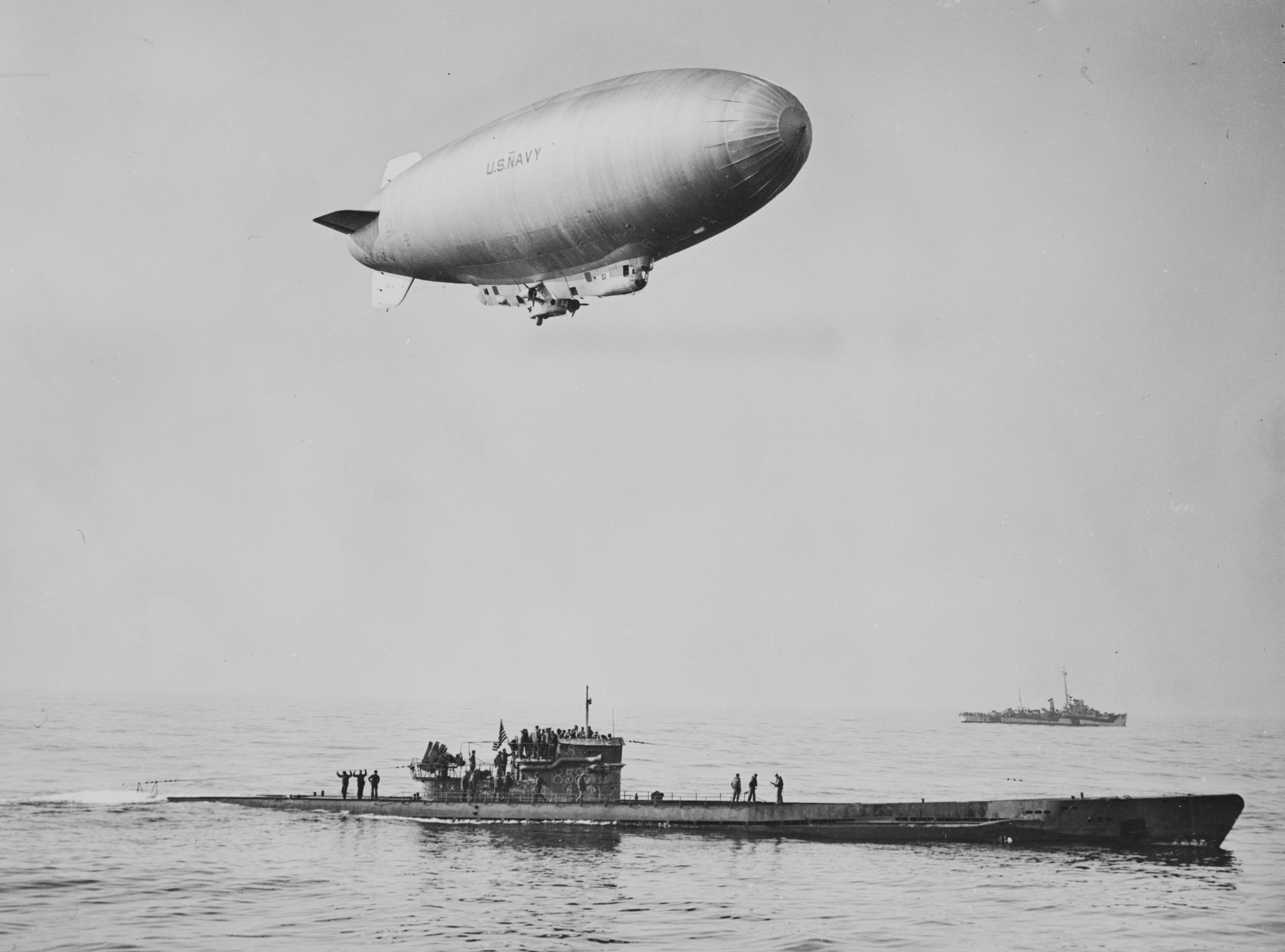
WORLD WAR II — Blimps were a vital and life-saving part of the U.S. Navy’s operations in World War II. More than 100 blimps (three-fourths of them made by Goodyear) were used for patrols and surveillance on both the Atlantic and Pacific coasts. Blimps flew in air support of convoys sailing across the Atlantic, helping to prevent German U-boat attacks. For a two-year period of the war, blimps escorted 89,000 vessels across the ocean without a single loss to enemy submarines.
ZEPPELINS — German engineer Ferdinand von Zeppelin designed rigid, cigar-shaped airships for warfare in World War I. His airships were used to bomb Paris and London. This led to greater military interest in the use of zeppelins, blimps, balloons, and all types of high-flying aircraft. After the war, Zeppelin Corp. and Goodyear formed a joint venture to develop blimps in the U.S., with Goodyear owning two-thirds of the venture. This partnership ended in 1940.
BLIMPS BY THE NUMBERS
246 Feet – That’s the length of each of the Goodyear Blimps, about 80 percent of the length of a football field.
Three – Each Goodyear Blimp holds the equivalent of three Olympic-sized swimming pools of Helium.
100 Days – Each Blimp travels more than 100 days per year, with trips ranging from three days to three weeks.
1,000 to 1,500 Feet – Goodyear Blimps fly between 1,000 and 1,500 feet in the air.
73 – The Goodyear Blimps travel at speeds of up to 73 miles per hour.
SOME SOURCES USED FOR THIS BLIMPOLOGY
Goodyear, “Timeline History of the Goodyear Blimp,” 2025
Goodyear’s past CEOs retrieved from this site: https://www.historyoasis.com/post/goodyear-ceo-history
Some of Goodyear’s important role in World War II aviation came from this site: https://vintageaviationnews.com/warbird-articles/visiting-the-former-goodyear-corsair-factory-in-akron-ohio.html
Fram Museum (Norway) website: https://frammuseum.no/polar-history/expeditions/the-norge-flight-1926/Rebecca Grant, “Are Airships For Real?” Air Force Magazine, November 2006, pps. 67-70
Sarah Kuta, “A Brief History of the Goodyear Blimp, Which Celebrates its 100th Anniversary This Year,” Smithsonian Magazine, January 6, 2025
Chad Murphy, “Goodyear blimp birthplace honored as part of Ohio aviation history. Here’s what that means” Akron Beacon Journal July 22, 2024 https://www.beaconjournal.com/story/news/2024/07/22/goodyear-blimp-wingfoot-lake-ohio-air-space-trail/74472658007/
Taira Payne “The Loss of the USS Macon, 12 February 1935, U.S. Naval Institute, February 2023 , https://www.usni.org/magazines/naval-history-magazine/2023/february/loss-uss-macon-12-february-1935#:~:text=But%20three%20airship%20crashes%20largely,California%20on%2012%20February%201935.
Dale Topping, “When Giants Roamed the Sky: Karl Arnstein and the Rise of Airships from Zepplin to Goodyear” (Akron, University of Akron Press, 2000)
Website of Rocky Mount Air Solutions, www.rockymountainair.com
T.R Witcher, “History Lesson: Goodyear Airdock,” Civil Engineering, November 2016
Editing note: Eyeoncleveland.com will have some details about the three-day Goodyear Blimp flyover in Akron and the 100th anniversary celebration on Monday, June 2. We are NOT covering the flyovers; however, we will provide links to social media platforms of the Goodyear Blimp and of people who post pictures of them.
 eyeoncleveland