
Nation veers towards financial doom; only a course change can save the U.S.
Second in a Series
By JOHN KEREZY, eyeoncleveland.com founder
CUYAHOGA FALLS, June 17, 2025 — Since the first story in this series in April on billions of dollars in both wasteful and unapproved federal spending (see link just below) one of the world’s three leading credit rating agencies, Moody’s Ratings, downgraded the credit rating of the United States.
Citing the nation’s inability to address its large and growing deficits, Moody’s announced the downgrade on May 16. It means that — for the first time ever — all three major credit rating agencies have downgraded U.S. credit below their top rating.
In its May 16 announcement, Moody’s Ratings listed three main reasons for the downgrade. They are:
- Growing debt caused by increased federal spending and reduced revenues from tax cuts. Moody’s includes the assumption that extension of the 2017 TCJA provisions will add $4 trillion to the debt over the next decade.
- Growing federal interest payments, driven by rising interest rates. The cost of financing the U.S. debt has increased rapidly, driven by higher Treasury yields since 2021 (more on this below).
- Warning that “successive US administrations and Congress have failed to agree on measures to reverse the trend of large annual fiscal deficits and growing interest costs. . . . In turn, persistent, large fiscal deficits will drive the government’s debt and interest burden higher…”
Greater numbers of economists are also pointing out the perils of ever-larger federal debt. JP Morgan Chase Chief Executive Jamie Dimon is predicting an economic crisis unless the U.S. takes action to stop its spiraling national debt.
“You are going to see a crack in the bond market, OK?” Dimon said at the end of May at the Reagan National Economic Forum in California. “…I think this time is different. This time we have to get our act together and do it very quickly.”
Because of growing federal budget deficits ($1.8 trillion in FY 2024), the government has resorted to selling ever-greater amounts of Treasury notes (debts maturing in 2-10 years) and bonds (debts maturing in 20 to 30 years). Outstanding Treasury notes, bonds and bills totaled nearly $29 trillion at the end of May 2025. That’s about 95% of annual U.S. economic output, and double the amount of federal government borrowing just eight years ago.
This leads to the obvious: The more money the government borrows, the less money available for lending in other markets, and the more expensive that money becomes for borrowers.
The yields on Treasury notes also set a baseline on borrowing costs all across the economy. For example, the yield on a 10-year Treasury note is a major determinant for 30-year mortgage rates. When the 10-year Treasury note yield was at 0.91% at the beginning of 2021, the 30-year mortgage rate hit a record low of 2.65% (according to Freddie Mac). Just 52 months later — May 2025, last month — 30-year mortgage rates were around 6.76% to 7.06% and, the 10-year Treasury note yield was in the 4.5% range.
The Federal Reserve Board raised interest rates seven times in 2022 in an effort to slow down inflation and to make up for the economic upheaval following Covid-19 in 2020-2021. One consequence of those rate increases is greater federal dollars now servicing the rising national debt.
In FY 2024, our federal government spent more money in interest on national debt ($882 billion) than it did in defense ($841.4 billion). According to the General Accounting Office, interest (all payments) on the debt in FY 2024 was $1,126.5 trillion, the highest ever recorded.
One Big Beautiful Bill Act
Most economists state that the net effect of the One Big Beautiful Bill Act (OBBBA), or the budget reconciliation bill in the current Congress (which passed the House of Representatives last month) will be horrendous for the federal government’s debt and deficit. Moody’s Ratings believes that the deficit could increase by as much as $4 trillion in the next 10 years (see above).
The Brookings Institution’s Kyle Pomerleau agrees with other projections that the OBBBA, if adopted in the Senate, would increase the federal budget deficit by about $2.5 trillion over the next decade. This would mean additional borrowing on the part of the Treasury Dept. Time will tell if the bill becomes law, but it doesn’t bode well for the federal government’s deficit or debt situation.
The OBBBA bill which passed the House of Representatives on May 22, extends the debt ceiling by another $4 trillion, or essentially to just over $40 trillion. The most recent Senate version of bill would raise the debt ceiling by $5 trillion.
Of note: President Trump and others are now calling for an elimination of the “official” Congressional debt limit. Not that the debt limit has had much effect: Congress has raised the federal debt limit 78 times since President Eisenhower first asked to do so in 1960.
What does the public think? How about young adults?
Survey after survey has shown that the general public is highly desirous of adopting measures which — it thinks — would help curb some of Washington’s excesses. A Susquehanna Polling and Research Inc survey in Fall 2024 found that 71 percent believe more limitations on federal power are necessary, and 88 percent favor federal term limits.
I was curious what students in one of my courses, COMM 1010 (Principles of Speech Communication) thought about some of the these same issues. We have a requirement that students in COMM 1010 deliver persuasive speeches in the class, and to help facilitate that assignment I’ve conducted class surveys on matters of public interest in years past. I did a survey in two sections of COMM 1010 this past spring. (You can find the complete set of survey questions and answers just below.) What I uncovered surprised even me: 77% of the students were in favor of federal term limits, and 87% were in favor of a federal balanced budget.
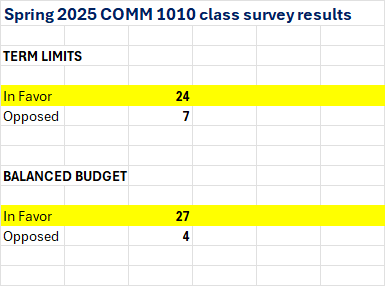
You can see exact wording of questions below.
This is non-scientific of course, as a much larger and objectively-drawn population sampling would be needed to predict with accuracy whether the opinions reflect public opinion. But younger adults are much more likely to believe that Washington DC is the problem, not the solution, to many of the nation’s ills.
NEEDED: Federalism as the Founders intended
Robert Natelson, a senior fellow with the Independence Institute, believes that calling for a Convention of States is essential to restoring what’s known as FEDERALISM. Under federalism, states have the power to rein in a runaway federal government. His paper about it is at the end of this story, if you wish to read it.
Natelson is in excellent company. In one of his Federalist Papers, James Madison wrote this: “The powers delegated by the proposed constitution to the federal government are few and defined. Those which are to remain in the state governments are numerous and indefinite.”
There’s a lot of proof supporting what Madison believed and what Natelson wrote. Just count the words in the 1787 Constitution itself. The word CONGRESS is mentioned there 23 times. PRESIDENT is mentioned 30 times. The JUDICIARY, just six times. The words STATE or STATES are mentioned 174 times in the Constitution. These numbers are from the National Constitution Center. (Natelson’s article is below if you wish to read it.)
Without federalism — without states exerting their power again under a Convention of States — Washington won’t fix its economic woes or other problems. Britt Hume has been covering Washington DC and national affairs as a journalist for 55 years. He is now saying repeatedly, to anyone who’ll pay attention, that Congress is completely unable now to control spending. The states MUST step in and act.
ANOTHER CALL TO ACT
As stated in the first story in this series, fortunately our Founders foresaw a day when the federal government would accumulate too much power and act recklessly with it. That’s why Article V is in the constitution. One key provision of Article V allows states to call for what’s known as a COS — or Convention of States — to amend the Constitution.
AND SO ….
I chose to go to Columbus on June 17 to testify to the Ohio Senate in favor of SJR 3, a resolution from Ohio calling on the federal government to hold a Convention of States for three purposes:
- Federal Term Limits
- Balance the Federal Budget
- Limit the power of the Federal Government
My written testimony is below if you wish to read it.
The federal government’s spending is on a path which will enslave our children and our grandchildren to this burdensome debt for all of their working lives.
Is that what we want?
There is only one solution to address the horrific problem. Fortunately, the authors of our Constitution did provide a way to do so, through what is in Article V of our government document. In it, there is a provision for a Convention of States (COS) to make amendments to our Constitution.
Think about it: Do you believe the administrative state in Washington DC will stop exceeding its authority and stop unauthorized spending? Do you think the elected members of Congress would agree to a balanced budget? Or to term limits for themselves?
No.
But we the people – through the state amendment process, can bring about changes and improvements in a way that will save the government, and our posterity, from the terrible danger we’re facing.
Here is a link to a video from the Convention of States which explains how such a convention to amend the Constitution would work:
https://www.youtube.com/watch?v=oQ3HstQk03Y
If you agree, I suggest you do two things:
1) Contact your state representative and/or senator, and tell them you support your state becoming one that advocates for calling for a Convention of States.
2) Sign the COS petition, linked here: https://conventionofstates.com
ABOUT EYEONCLEVELAND.COM
I began eyeoncleveland.com in 2015 to provide a space for some of my Cuyahoga Community College students to have published stories. About 15 of them have written news and features of various types which have appeared here since then.
As a former U.S. Senate press secretary and someone who was peripherally involved with public and government affairs before becoming a full-time faculty member at Cuyahoga Community College, I also use this space to provide some commentary and insight on government and politics.
Views expressed on http://www.eyeoncleveland.com are those of the authors or myself, and not those of Cuyahoga Community College nor of the students’ employers.
SOME SOURCES USED FOR THIS STORY
https://news.bgov.com/daily-tax-report/senate-republicans-release-revised-trump-tax-debt-limit-bill
 eyeoncleveland