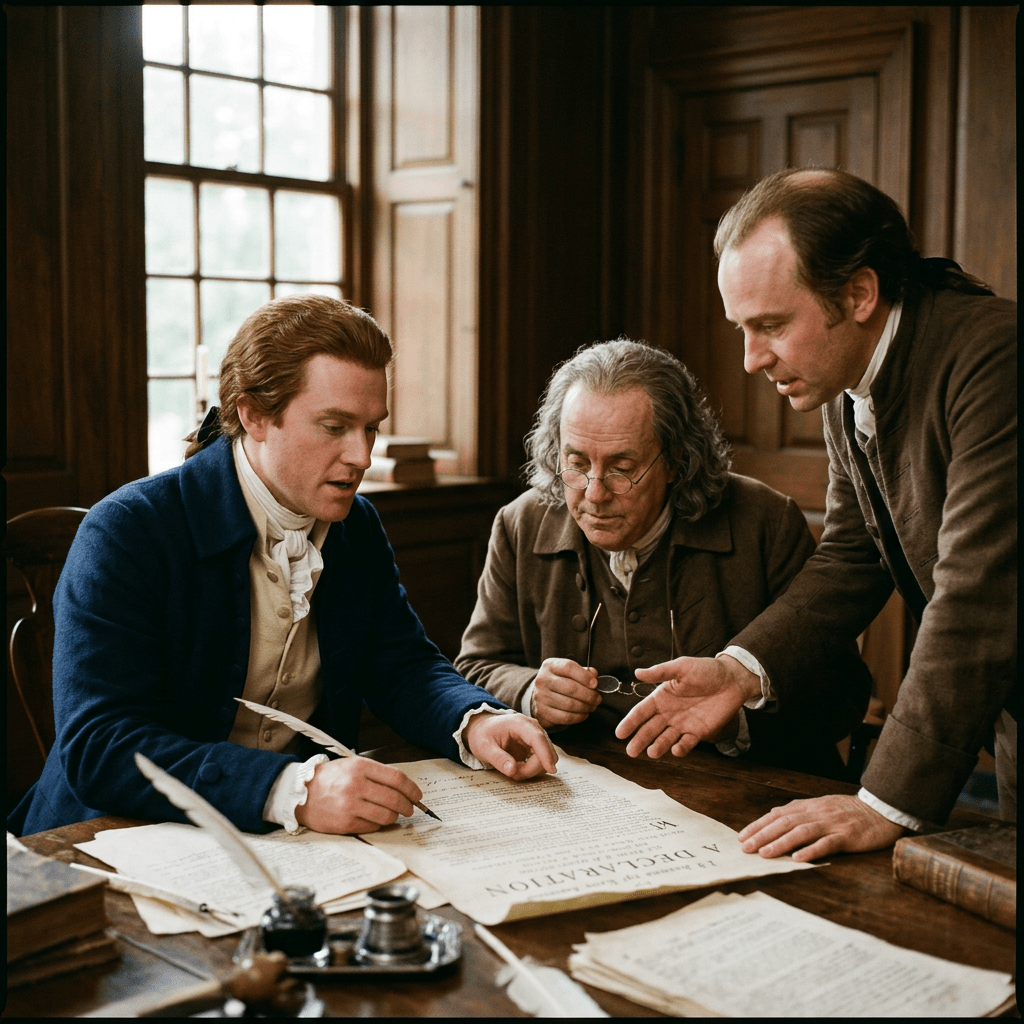
Philosophical, religious, and practical underpinnings of the Declaration of Independence.
By JOHN KEREZY, eyeoncleveland.com founder
Part II (link to Part I is below)
CUYAHOGA FALLS, JULY 27 – Suppose many states in the U.S. passed resolutions disavowing the actions of our federal government? Suppose cities, townships, and other government entities all did the same?
That was the real and growing dilemma facing the Second Continental Congress in the first half of 1776. The New Hampshire colony’s provincial congress, meeting in Exeter, declared itself independent of Great Britain. It adopted a constitution on January 5, 1776, allowing the colony to rule itself by the authority of its own people. [i]
And New Hampshire was by no means alone. In April, North Carolina’s legislature passed the Halifax Resolves, instructing its Congressional delegates to back independence from Great Britain. Rhode Island renounced its allegiance to King George III in May 1776. That same month, Virginia declared itself a free and independent state via a convention. A month later, it instructed its Continental Congress delegates to propose independence. [ii]
What happened in Philadelphia in May-June-July of 1776 was far more than just an uprising. An analysis of the period indicates the actions of the Second Continental Congress was instead a reaction to more than a decade of British mismanagement, and later cruelty and oppression towards its American colonies and colonists. And as the injustices accelerated, Americans increasingly regarded themselves not as subjects to a king more than 4,000 miles distant, but rather citizens of a new, more democratic nation, independent of Great Britain.

In her 1998 work American Scripture: Making the Declaration of Independence, the late historian Pauline Maier documents about 90 different local and provincial bodies (towns, grand juries, colonial legislatures, the Presbyterian Church, even the New York City’s Fire Dept.) which issued their own declarations favoring independence before July 4, 1776. Some of them listed grievances against King George III and legislative law overreaches, as well as common law villainies, which the British government foisted upon the American colonies. [iii]
INJUSTICES, NATURAL RIGHTS, NATURAL LAW
This is significant: If we begin with Thomas Paine’s pamphlet “Common Sense” in early 1776 and then trace it through to the vote for independence that the Second Continental Congress cast on July 2, 1776, we can trace a growing sentiment in the 13 American colonies for independence.
And the reasons were many: Thomas Jefferson enumerated 27 grievances, complaints against King George III, in the Declaration of Independence. They fall into three general categories: injuries to self-governance, assaults on personal liberty, and protections of the public good and safety.
Jefferson and the others assigned to the Declaration of Independence draft committee – John Adams, Benjamin Franklin, Robert Livingston and Roger Sherman — believed these grievances provided ample justification to break away from Great Britain, to declare the bonds dissolved, and to call the United States of America a new nation. Readers of the Declaration of Independence in the summer of 1776 paid great attention to those 27 grievances, and – if their minds weren’t already made up – many concluded that the British government and its monarch had indeed failed to protect the basic rights of the American colonists.
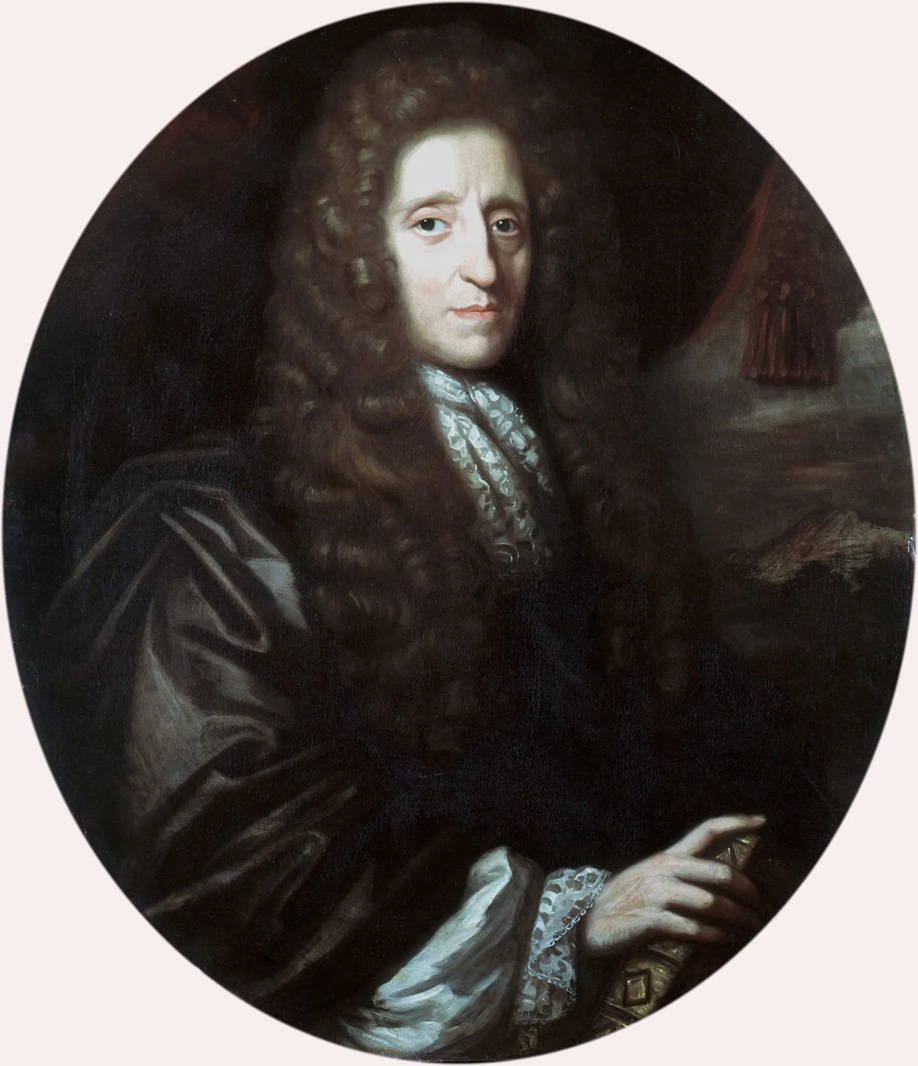
Jefferson and the other committee members also covered three foundational areas — natural rights, natural laws, and the right to revolution – in the Declaration of Independence. All three are under the general umbrella of the social contract, a concept first promulgated by 17th century British philosopher and political theorist John Locke. Historians know that Jefferson read Locke’s Second Treatise on Government at least three times, and fully adopted his thesis that just governments receive their power from the people they rule (“consent of the governed” are the exact words in the Declaration of Independence). [iv]
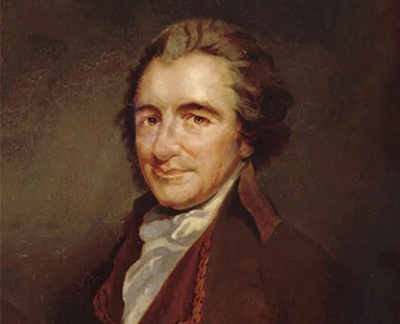
Natural law derives from a higher moral law, and from the creator – God. Writing about 15 years after America declared its independence, Thomas Paine explained it this way:
Every child born into the world must be considered as deriving its existence from God. The world is as new to him as it was to the first man that existed, and his natural right in it is of the same kind.[v]
Natural rights became delineated as (endowed by their Creator with certain inalienable rights — life, liberty, and the pursuit of happiness, again, the exact words in the Declaration). It is important to note that Jefferson’s original phraseology here was “we hold these truths to be sacred and undeniable.” Benjamin Franklin crossed out those last three words and replaced them with self-evident. A friend of Scottish philosopher David Hume, Franklin preferred Hume’s principle about analytic truths that were self-evident by definition and by virtue of reason. [vi]
Paine later provided a further explanation:
Natural rights are those which appertain to man in right of his existing. Of this kind are all the intellectual rights, or rights of the mind, and also all those rights of acting as an individual for his own comfort and happiness, which are not injurious to the natural rights of others. [vii]
AN APPEAL TO HEAVEN
Locke’s influence on Jefferson and other leading American colonists also had strong ties to God. Virtually all of the signers of the Declaration of Independence were protestants, some descendants of people fleeing to the American colonies due to religious persecution. In his Second Treatise on Government, Locke wrote this:
And where the Body of the People, or any single Man, is deprived of their Right, it is under the Exercise of a power without right, they have no Appeal on Earth, there they have a liberty to appeal to Heaven, whenever they judge the Cause of sufficient moment.[viii]
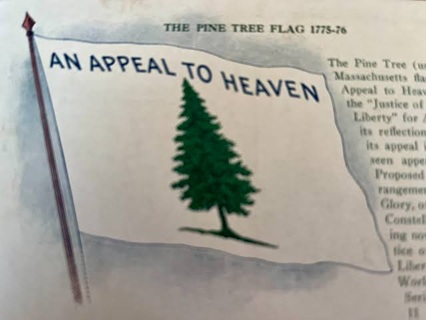
Locke’s treatise provided both a right for people to fight back against an unjust government with force, and to ask God to judge their cause. The “Appeal to Heaven” flag, also called a pine tree flag, came out of this concept at the onset of the Revolutionary War.
Brad Birzer, professor of history at Hillsdale College, points out that American colonists began considering themselves not as British subjects but as living in a separate nation as far back as 1761. They are almost to a person, Protestant in faith. And they are deeply, deeply Protestant. As Edmund Burke said, they are the most Protestant of Protestants. Many colonists also learned Greek and Latin in their limited schooling. [ix]
Birzer adds that, throughout almost the entire history of colonial experience, Britain had adopted a policy of salutary neglect towards its colonies. The colonies therefore had adopted various forms of self-governance. Many had their own legislatures. So, when the British government began passing laws (such as the Stamp Act of 1765) and placing taxes upon the colonists, it became a flashpoint that escalated into ever-greater colonial resentment against Great Britain’s rule.
So, it should be no surprise that the Declaration of Independence is also an appeal to God. In its first paragraph, the authors refer to the “Law of Nature and Nature’s God. In the second paragraph, Jefferson, Franklin, and all the authors agreed on the words “endowed by their Creator…”
In the final section of the Declaration, the authors are “appealing to the Supreme Judge of the world…” for their separation from Great Britain. And in the final sentence, “with a firm reliance on the protection of divine Providence,” the authors and the entire Continental Congress are appealing to heaven to help their new nation achieve its independence.
There’s one other dimension worth discussing as we conclude an analysis of the underpinnings of the Declaration of Independence. Jefferson had a 28th grievance in his original draft: One which condemned King George for slavery and the Transatlantic slave trade. Here are Jefferson’s original words:
He has waged cruel war against human nature itself, violating its most sacred rights of life & liberty in the persons of a distant people who never offended him, captivating & carrying them into slavery in another hemisphere, or to incur miserable death in their transportation thither. this piratical warfare, the opprobrium of infidel powers, is the warfare of the CHRISTIAN king of Great Britain. determined to keep open a market where MEN should be bought & sold, he has prostituted his negative for suppressing every legislative attempt to prohibit or to restrain this execrable commerce: and that this assemblage of horrors might want no fact of distinguished die, he is now exciting those very people to rise in arms among us, and to purchase that liberty of which he has deprived them, & murdering the people upon whom he also obtruded them; thus paying off former crimes committed against the liberties of one people, with crimes which he urges them to commit against the lives of another. [x]
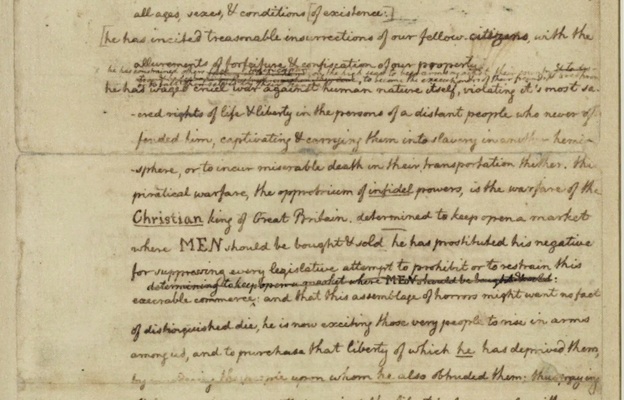
The emphasis above is in Jefferson’s original draft. Continental Congress representatives from South Carolina and Georgia insisted on removal of this paragraph before they would support the Declaration of Independence.
Taken in context, there can be no doubt that when Jefferson penned “all men are created equal,” he included Black men in his belief. Professor Birzel marvels at how different the world might have been if this 28th grievance against the King of England had stayed in the Declaration.
LINK TO PART ONE IN THIS SERIES: https://wp.me/p6cQl4-1ot
FOR CONSIDERATION OR DISCUSSION
- The federal government’s debt hit $10 trillion, an all-time high, on September 30, 2008. In August, the debt is expected to surpass $40 trillion, or four times that amount. Congress is unable to control spending, and continues to ignore calls from dozens of states to take up a balanced budget amendment to the U.S. Constitution. What recourse do today’s younger Americans have, as federal spending condemns them to a lifetime of paying ever-higher taxes to pay down the debt? (NOTE: the Congressional Budget Office is estimating that the federal government will spend $1.039 trillion just on servicing the debt in FY 2026.) [xi]
- Congressional representatives are elected by just a very small percentage of American voters. Some, like Kentucky’s Senator Mitch McConnell (41 years) and New York’s Chuck Shurmer (45 years), are serving in government for more than half of their lifetimes. Congress has also ignored repeated calls from dozens of states to take up a term-limit amendment to the U.S. Constitution. Is there any correlation between the lack of term limits and a growing belief among young Americans (those aged 18 to 29) that they’ve lost agency: They can no longer shape what happens next? This age group’s trust in the federal government has fallen to 15 percent, an all-time low. [xii]
RECOMMENDED FOR FURTHER READING
Brad Birzer, “The Declaraton of Independence: A Radical Experiment in Liberty” 2026
Pauline Maier, “American Scripture: Making the Declaration of Independence” 1998
ENDNOTES
[i] Andrew Cline, Josiah Bartlett Center for Public Policy, “The importance of New Hampshire’s 1776 constitution”
[ii] American Revolution Museum at Yorktown, “What factors finally pushed the Second Continental Congress to declare independence in July 1776?”
[iii] Pauline Maier, “American Scripture: Making the Declaration of Independence,” Knopf Doubleday Publishing, 1998 Here is a terrific video of Professor Maier explaining her research and findings. https://www.gilderlehrman.org/history-resources/videos/american-scripture-making-declaration-independence
[iv][iv] Locke, John | Internet Encyclopedia of Philosophy https://share.google/5JBixVnnf67seJ3iP
[v] Thomas Paine, “The Rights of Man” first published in 1791. This author read the Pelican Classics reprinting, published by Pelican Books in 1969. See p. 88
[vi] Walter Issacson, “Benjamin Franklin: An American Life,” Simon & Schuster, 2003, page 312
[vii] Paine, op cit, p. 90
[viii] Locke, op cit
[ix] Brad Birzer, “The Declaration of Independence: A Radical Experiment in Liberty,” Hillsdale College, 2026 Listen to Episode 369, Radio Free Hillsdale Hour, “The Declaration of Independence A Radical Experiment in Liberty,” linked here: https://podcast.hillsdale.edu/the-declaration-of-independence-a-radical-experiment-in-liberty/
[x] American Battlefield Trust, https://www.battlefields.org/learn/primary-sources/jefferson-condemns-slave-trade-declaration-independence
[xi] Congressional Budget Office, “The Budget and Economic Outlook: 2026 to 2036” Link is here: https://share.google/pKLLxxhBkiBfjYq8Z
[xii] 52nd Edition, Spring 2026, The Institute of Politics at Harvard University Link is here: https://share.google/uQ8s5CIrO09bH3r5E

